

Präsenzveranstaltung | 6. – 8. Juli 2026 | experimenta Heilbronn
Topics: Fault-Tolerant Algorithms, Quantum Error Correction, Quantum Simulation

Über das Symposium
“And by golly it’s a wonderful problem, because it doesn’t look so easy.” (R. Feynman)
Die Simulation quantenphysikalischer Systeme gilt als eines der ersten Anwendungsfelder, in denen Quantencomputer ihre Überlegenheit gegenüber klassischen Methoden unter Beweis stellen werden. Um diesen Meilenstein zu erreichen, dessen disruptive Wirkung zahlreiche Industriezweige betreffen könnte, braucht es ein gemeinsames Vorgehen: die Entwicklung effizienter, praxisnaher Quantenalgorithmen ebenso wie den Aufbau fehlertoleranter, fehlerkorrigierender Quantencomputer.
Das Symposium FTQC4NSc bringt Forschende und Expertinnen und Experten aus der Industrie zusammen. Aktuelle Fortschritte sowie Herausforderungen bei der Entwicklung fehlertoleranter Quantensysteme und von Quantenalgorithmen für Materialwissenschaften und Quantenchemie werden diskutiert.
Die Veranstaltung ist die 2026er Ausgabe einer Symposienreihe des Fraunhofer Forschungs- und Innovationszentrums für Angewandte Quanten-KI in Heilbronn mit drei Zielen: den Wissensaustausch fördern, fachliche Vernetzung stärken, Wissenstransfer nach Baden-Württemberg sowie in die sich dynamisch entwickelnde Quantentechnologieregion Heilbronn unterstützen.
Als flaQship organisieren wir diese Veranstaltung im Rahmen unserer Aktivitäten im Kompetenzzentrum Quantencomputing Baden-Württemberg (KQCBW), gemeinsam mit dem Center for Advanced Systems Understanding (CASUS) und der Hochschule Heilbronn (HHN).
Confirmed Speakers
- Prof. Barbara Terhal, TU Delft
- Prof. Zoë Holmes, EPFL
- Prof. Jens Eisert, FU Berlin
- Prof. Lin Lin, UC Berkeley
- Prof. Thomas D. Kühne, CASUS
- Prof. Jakob Kottmann, Universität Augsburg
- Prof. Hans Peter Büchler, Universität Stuttgart
- Prof. Richard Kueng, Johannes Keppler Universität Linz
- Dr. Nick Blunt, Riverlane
- Dr. Christian Gogolin, Covestro
- Dr. Nathan Fitzpatrick, Quantinuum
- Dr. Guang Hao Low, Google Quantum AI
- Dr. Tristan Müller, IBM
- Dr. Nicholas Rubin, Google Quantum AI
- Dr. Fedor Šimkovic, IQM Quantum Computers
- Dr. Ivano Tavernelli, IBM Quantum
- Dr. Stefan Knecht, Algorithmiq
- Dr. Jan Reiner, HQS Quantum Simulations
- Dr. Michael Streif, Boehringer Ingelheim
Important Dates:
Call for Contributions öffnet –
– Deadline Call for Contributions
Feedback Contributions –
– Deadline Registration
Symposium FTQC4NSc –
Programm
| Day 1 | Day 2 | Day 3 | |||
| 08:45 | Opening | 08:30 | Invited Talk VII: Hans Peter Buechler | 08:30 | Invited Talk XIV: Nathan Fitzpatrick |
| 09:00 | Invited Talk I: Jens Eisert | 09:15 | Invited Talk VIII: Tristan Müller | 09:15 | Invited Talk XV: Nick Blunt |
| 09:45 | Invited Talk II: Barbara Terhal | 10:00 | Contributed Talk IV: Theo Dessertaine | 10:00 | Contributed Talk VIII: Soumya Sarkar |
| 10:30 | Break | 10:20 | Break | 10:20 | Break |
| 11:00 | Invited Talk III: Jakob Kottmann | 10:50 | Invited Talk IX: Nicholas Rubin | 10:50 | Invited Talk XVI: Jan Reiner |
| 11:45 | Contributed Talk I: Yu Wang | 11:35 | Contributed Talk V: Carlos Benavides-Riveros | 11:35 | Contributed Talk XI: Marvin Gajewski |
| 12:05 | Contributed Talk II: Sascha Heußen | 11:55 | Contributed Talk VI: Danial Motlagh | 11:55 | Contributed Talk X: Marius Bothe |
| 12:25 | Lunch Break | 12:15 | Lunch Break | 12:15 | Lunch Break |
| 13:55 | Invited Talk IV: Lin Lin | 13:45 | Invited Talk X: Christian Gogolin | 13:45 | Invited Talk XVII: Ivano Tavernelli |
| 14:40 | Invited Talk V: Guang Hao Low | 14:30 | Invited Talk XI: Stefan Knecht | 14:30 | Invited Talk XVIII: Fedor Šimkovic |
| 15:25 | Break | 15:15 | Break | 15:15 | Invited Talk XIX: Michael Streif |
| 15:55 | Invited Talk VI: Jadwiga Wilkens | 15:45 | Invited Talk XII: Zoë Holmes | 16:00 | Conclusion |
| 16:15 | Contributed Talk III: César Feniou | 16:30 | Invited Talk XIII: Thomas Kühne | 16:15 | End |
| 16:35 | End | 17:15 | Contributed Talk VII: Matthias Deiml | ||
| 18:30 | Conference Dinner | 17:35 | End | ||
| 18:00 | Poster Session |
A framework for spin-adapted quantum chemistry on quantum computers
Dr. Nathan Fitzpatrick (Quantinuum)
Quantum computers promise to transform molecular simulation, but many existing algorithms overlook the powerful role of spin symmetry in chemistry. The Quantum Paldus Transform provides a new framework that makes spin adaptation a built-in feature of quantum computation.
At its core, the transform connects two representations of electronic states: the conventional occupation-number basis used in quantum chemistry, and a symmetry-adapted basis that organises states by total spin, particle number, and orbital symmetries. This shift, grounded in mathematical structure known as Paldus duality, allows quantum devices to work directly with spin-pure states – the natural language of chemistry.
The benefits are considerable. Spin-free Hamiltonians reduce to block-diagonal, sparser forms, enabling more efficient simulations. The transform itself admits polynomial-cost implementations and even highly compact circuit constructions. Beyond simulation, the framework facilitates efficient preparation of Configuration State Functions (CSFs) and naturally embeds quantum information in decoherence-free subsystems, offering potential protection against certain noise channels.
By extending the quantum Schur transform into the fermionic setting, the Quantum Paldus Transform establishes a principled and practical route for exploiting spin symmetry in quantum algorithms. This framework opens new directions for scalable, accurate, and symmetry-aware quantum chemistry algorithms on quantum computers.
Bringing quantum logic into quantum error correction
Prof. Jens Eisert (Freie Universität Berlin)
Quantum computers promise computational advantages over classical supercomputers for certain tasks. However, this promise can only be realized if effective methods are employed to address the unavoidable errors present in practical implementations. While quantum error mitigation will continue to play an important role, it alone cannot enable scalable quantum computing [1]. Quantum error correction, by contrast, can detect and correct errors without revealing any logical information. Although the concept is not new, recent years have witnessed remarkable progress in the field. This advancement has been largely driven by substantial experimental breakthroughs, which in turn have accelerated theoretical developments. Today, quantum error correction is widely regarded as one of the fastest-growing subfields of quantum computing. This talk will guide you through several recent developments, with an emphasis on our own contributions to the field over the past two years [2–8]. We will explore the design of new Floquet codes [2, 3], accompanied by novel graphical calculi [2], and discuss detector error models [4].
At the heart of this talk lies one of the most actively discussed questions in the field today: how to perform practical quantum logic using quantum low-density parity-check (qLDPC) codes. While the mere existence of “good” such codes with highly attractive parameters has already marked a significant breakthrough, recent work has increasingly focused on how to realize fault-tolerant quantum computation with them in practice. The core part of the talk will present a particularly promising scheme that enables the compilation of fault-tolerant logical operations. To address the challenge that logical qubits do not necessarily map to disjoint sets of physical qubits, we introduce clustered-cyclic codes [5]—a family of quantum low-density parity-check codes with finite-size instances such as [[136,8,14]] and [[198,18,10]], which are competitive with state-of-the-art constructions. These codes admit a directly addressable logical basis, enabling highly parallel logical measurement layers, and feature simple logical operators. We further present properties of a family of planar qLDPC codes that achieve parameters as attractive as permitted by known no-go theorems [6]. We will also address the challenging problem of decoding [7,8], which corresponds to the classical task of determining suitable corrections from syndrome information. Finally, an outlook will highlight future directions for the field, including just-in-time decoding for high-threshold decoding of non-Pauli codes enabling two-dimensional universality [9], as well as a broader discussion of the challenges that lie ahead [10].
[1] Nature Phys. 20, 1648 (2024).
[2] PRX Quantum 6, 010360 (2025).
[3] PRX Quantum 5, 010342 (2024).
[4] Quantum 9, 1905 (2025).
[5] arXiv:2603.05398 (2026).
[6] In preparation (2026).
[7] Nature Comm. 16, 8214 (2025).
[8] PRX Quantum 5, 020349 (2024).
[9] arXiv:2604.02033 (2026).
[10] arXiv:2510.19928 (2025).
End-to-End Efficiency in Dissipative Preparation of Thermal and Ground States
Prof. Lin Lin (University of California, Berkeley / Lawrence Berkeley National Laboratory)
Inspired by natural cooling processes, dissipation has emerged as a powerful paradigm for preparing low-energy states of quantum systems, including thermal and ground states. In contrast to traditional quantum algorithms that rely on coherent evolution followed by final measurement and postselection, dissipative state preparation involves repeated mid-circuit measurements. This makes runtime analysis significantly more challenging, especially for non-commuting Hamiltonians. Recent advances, such as the development of Kubo-Martin-Schwinger (KMS) detailed-balanced Lindbladians and protocols for dissipative ground state preparation, have enabled not only efficient algorithms, as measured by the simulation cost per unit time, but also end-to-end runtime guarantees, as measured by the mixing time—the timescale required to reach the target quantum state from any initial state. In certain cases, sharp estimates on mixing times can be rigorously established. I will present these developments, and discuss how to simplify such protocols for efficient implementation on early fault-tolerant quantum devices while maintaining end-to-end efficiency.
Fast logic for the surface code: a challenge for decoding
Prof. Dr. Barbara M. Terhal (Delft University of Technology)
Transversal logical gates offer the opportunity for fast and low-noise logic, particularly when interspersed by a single round of parity check measurements of the underlying code. Using such circuits for the surface code requires decoding across logical gates, complicating the decoding task. We show how one can decode across an arbitrary sequence of transversal gates for the unrotated surface code, using a fast “logical observable” minimum-weight perfect matching-based decoder, and benchmark its performance in Clifford circuits under circuit-level noise. We discuss challenges and ideas in generalizing this to windowed logical observable matching decoders.
Fitting quantum chemistry simulations of early fault tolerant quantum computers
Dr. Christian Gogolin (Covestro)
It is intuitively plausible and widely believed that quantum computers are naturally good at simulating other quantum many-body systems such as those relevant in statistical mechanics, condensed matter physics, and chemistry. But is that actually true? How far are we from running such simulations on early fault-tolerant machines? How confidently and on what level of abstraction can we estimate the quantum resources required, and will quantum break even with classical in runtime and system size regime that is practically relevant. In this talk I will try (at least partially) answer some of these questions and present so of the relevant recent results from the quantum computing group at Covestro.
From Quantum Algorithms to Better Therapies and Materials: Transitioning from Near-Term to Early Fault-Tolerant Impact in Life Sciences and Materials Discovery
Dr. Stefan Knecht (Algorithmiq)
Quantum computing is at the threshold of transforming molecular simulation, offering solutions to some of the most intractable challenges in computational chemistry. One of the areas where this transformation is urgently needed is photodynamic therapy (PDT) drug discovery, a highly promising approach to targeted cancer treatment. PDT drugs must be carefully designed to optimize light absorption, reactive oxygen species generation, and excited-state stability. In this talk, I will outline our project, awarded as the sole winner of the Wellcome Leap Quantum4Bio Global Challenge [1] that is designed to address these challenges by building the first scalable quantum simulation pipeline for PDT drug discovery, allowing for the rational design of next-generation photosensitizers. In particular, I will discuss a series of groundbreaking advancements, enabling largescale quantum chemistry simulations that were previously infeasible and setting the stage for the first credible demonstration of useful quantum advantage in molecular modelling.
With these innovations at hand, I will present an end-to-end procedure —from defining a molecular structure to computing error-mitigated and error-corrected ground- and excited-state energies as well as molecular properties for molecules and materials using contemporary quantum hardware at a 50+ qubit scale. This marks a significant step towards practical, early-fault tolerant hardware-compatible quantum chemistry simulations for molecular systems as well as materials.
[1] https://wellcomeleap.org/q4bio_prize_announcement/
Imaginary-time evolution in the age of quantum computing
Dr. Fedor Šimkovic (IQM Quantum Computers)
Imaginary-time evolution (ITE) is a central framework for computing ground states of quantum systems, with broad applications in condensed matter physics, quantum chemistry, and related fields. Many variants of ITE have been developed, including approaches based on tensor networks and quantum Monte Carlo. On quantum computers, however, a direct implementation of ITE is obstructed by its intrinsically non-unitary character. This challenge has motivated a rapidly growing body of quantum and hybrid quantum-classical algorithms designed to emulate or approximate imaginary-time dynamics.
In this talk, Šimkovic will review recent progress in ITE methods for quantum computers and present several of their contributions to this area. He will first discuss an operator-projected formulation of variational quantum imaginary-time evolution, combined with Majorana propagation. He will then describe hybrid stochastic algorithms inspired by auxiliary-field quantum Monte Carlo and full configuration-interaction quantum Monte Carlo. Next, he will introduce a stochastic implementation of ITE based on quantum signal processing primitives. Finally, he will give a short introduction to the augmented ITE formalism, which can dramatically accelerate convergence relative to standard ITE and may have implications across a broad range of imaginary-time evolution methods.
Learning to predict ground state properties of gapped Hamiltonians
Prof. Dr. Richard Kueng (Johannes Kepler University Linz)
Classical machine learning (ML) provides a potentially powerful approach to solving challenging quantum many-body problems in physics, chemistry and material science. However, the advantages of ML over traditional methods have not been firmly established. In a series of works, we prove that classical ML algorithms can efficiently predict ground-state properties of gapped Hamiltonians after learning from other Hamiltonians in the same quantum phase of matter. By contrast, under a widely accepted conjecture, classical algorithms that do not learn from data cannot achieve the same guarantee.
Our proof technique combines mathematical signal processing with quantum many-body physics and also builds upon the recently developed framework of classical shadows. I will try to convey the main proof ingredients and also present numerical experiments that address the anti-ferromagnetic Heisenberg model and Rydberg atom systems.
This is joint work with Hsin-Yuan (Robert) Huang, Giacomo Torlai, Victor Albert, Laura Lewis, Viet Tran and John Preskill.
Leveraging low energy assumptions for quantum speedups
Dr. Nicholas Rubin (Google Quantum AI)
We present a method of integrating low-energy assumptions into a variety of quantum algorithms for physical simulation that leverages Hamiltonians represented as a sum of squares and spectral amplification. Spectral amplification minimizes query costs by useful uncertainty propagation when performing a parameter estimation task if the initial state is in the low-energy sector of a non-negative Hamiltonian. The non-negative Hamiltonian representations we utilize are sum-of-squares certificates on the lowest eigenvalue. This work connects non-commutative polynomial optimization to quantum algorithms and is demonstrated to lower quantum gate complexities when computing the ground state of strongly correlated electronic systems in first and second quantization. We will also highlight how sum-of-squares Hamiltonian representations can be used in classical electronic structure simulation with potentially reduced costs.
Near-term and fault-tolerant quantum computing applications in the natural sciences
Dr. Ivano Tavernello (IBM Quantum)
Quantum computing is entering a new phase, moving from noisy intermediate-scale devices toward fault-tolerant architectures capable of delivering scalable and reliable quantum advantage. Within this evolving landscape, significant progress has been made in the design of algorithms and workflows that bridge near-term capabilities with long-term fault-tolerant quantum computing. In particular, the development of resource-efficient quantum algorithms, together with error-mitigation and early error-correction techniques, is paving the way toward practical applications aligned with the fault-tolerant roadmap pursued by IBM. In this talk, I will also briefly outline IBM’s roadmap toward fault-tolerant quantum architectures and the corresponding implications for algorithm design. From an application perspective, near-term and fault-tolerant quantum computing is expected to unlock transformative capabilities across a wide range of domains. These include combinatorial optimization and machine learning, as well as applications in healthcare and life sciences such as molecular modeling and drug discovery. In the physical sciences, quantum algorithms targeting quantum chemistry, materials science, and lattice gauge theories in high-energy physics are particularly promising, as will be outlined in this talk. Many of these problems remain fundamentally beyond the reach of classical methods due to the exponential complexity of strongly correlated and high-dimensional systems. Near-term and fault-tolerant quantum algorithms, enabled by robust logical qubits and scalable architectures, offer a pathway to address these challenges, with the potential to provide accurate simulations of complex molecular processes, many-body quantum systems, and fundamental physical phenomena.
One and Many-Body Aspects of Electronic Structure on Quantum Computers
Prof. Dr. Jakob Kottmann (University of Augsburg)
Quantum computation is currently at a stage where the applicability of quantum algorithms appears imminent, but their full potential remains an open question. A significant fraction of present-day quantum algorithmic research relies on numerical procedures to gain further insights and explore new applications. Here, one typically deals with numerous interconnected classical and quantum algorithmic components. In this talk, I will illustrate how quantum algorithmics and scientific software development can form a powerful symbiosis to tackle problems in electronic structure and other potential applications of quantum computers.
Parallel Quantum Chemistry on NISQ Computers: From RDMFT Subsystems to Embedded Materials
Prof. Thomas D. Kühne (CASUS)
A central obstacle for quantum chemistry on near-term quantum computers is not only the noise of present devices, but the size of chemically meaningful electronic-structure problems. We proposed a parallel hybrid quantum-classical algorithm based on reduced density-matrix functional theory (RDMFT) and the adaptive cluster approximation. Instead of mapping the full many-electron problem onto one large quantum circuit, the density-matrix functional is decomposed into a set of indirectly coupled subsystem functionals. Each subsystem can then be solved by a variational quantum algorithm, while the independence of the subsystem problems opens a natural route to parallel execution and reduces the qubit requirements per quantum processor.
In this talk I will present the main ideas behind this approach, its relation to variational quantum eigensolvers, and its demonstration for Hubbard-like systems on IBM superconducting quantum hardware. I will discuss how the method trades one monolithic quantum chemistry calculation for many smaller constrained minimization problems, and why this matters for NISQ-era devices with limited qubit counts, circuit depths, and coherence times.
I will then connect this perspective to our current work on CP2K active-space embedding for periodic battery materials. There, the same guiding principle reappears in a chemically more realistic form: isolate the strongly correlated local degrees of freedom, keep the environment classical, and use exact or quantum solvers only where they are needed. This provides a bridge from the original RDMFT-based parallel quantum chemistry concept toward practical quantum-computing-inspired workflows for materials simulations.
Pauli and Majorana Propagation Methods for Supporting Chemistry and Materials Workflows on Quantum Hardware
Prof. Zoë Holmes (EPFL)
Simulating quantum circuits classically is in general a hard task. However, certain families of quantum circuits may be practically or even provably efficiently simulable by use of specialized classical algorithms. Following on from Stefan Knecht’s talk on Algorithmiq’s end-to-end pipeline for quantum chemistry, this talk will focus on the role that such classical simulation methods can play within this pipeline, in particular for designing state-preparation circuits. We will cover Pauli propagation, which has recently been shown to enable efficient classical simulation of expectation values in quantum circuits and a wide range of noise-free quantum circuits. We will then discuss a generalization of this approach to fermionic systems via Majorana propagation, opening up new applications in quantum chemistry and materials science. In particular, we will discuss how propagation-based methods can be used to help construct approximate ground-state circuits, and how they can be efficiently combined with other classical and quantum subroutines in order to point towards promising applications of quantum devices.
Path to Starling – Realizing fault-tolerant quantum computation at scale
Dr. Tristan Müller (IBM Research)
Realizing large-scale, fault-tolerant quantum computing is essential for executing advanced quantum algorithms whose gate requirements exceed the capabilities of today’s devices by several orders of magnitude. In this talk, I will present IBM’s roadmap toward Starling, a fault-tolerant quantum computer targeted for 2029 and designed to support 200 logical qubits. I will highlight key recent milestones, including the development of bivariate bicycle codes and the bicycle architecture, which together significantly reduce the qubit overhead traditionally required for fault tolerance. I will also share our latest progress on real-time decoding of bivariate bicycle codes using Relay-BP. The talk concludes with an outlook on current and future technical challenges on our path to Starling.
Robust characterization of average gate set noise and cross-talk using gate-set shadows
Jadwiga Wilkens (Johannes Kepler University Linz)
As quantum processors scale, robust and scalable tools to characterize gate-level noise become indispensable. Randomized benchmarking (RB) and its many variants have emerged as the go-to protocols in practice: it yields a single number to characterize a gate set, the average gate fidelity, per irreducible subspace. It has been argued that RB can in principle be extended into a full tomographic framework (RB tomography), but large scale practical implementations even of partial tomographic information have long been hindered by the need for sequence inversion, explicit gate interleaving, and an the required measurement statistics. In this talk, we report on scalable implementations of a flexible and efficient variant of RB tomography called gate-set shadows on super-conducting qubit computing platforms. From one efficiently implemented randomized circuit experiment, we reconstruct marginals of the average noise channel, learn classically correlated quantum noise, including cross-talk, and infer a variety of diagnostic information and performance metrics.
Scientific Challenges to Apply Quantum Computing in Drug Design
Dr. Michael Streif (Boehringer Ingelheim)
Quantum computers hold the promise of outperforming classical systems and are widely regarded as the future of quantum chemistry and drug design. However, realizing this potential in real-world pharmaceutical applications requires addressing a far broader set of challenges than those typically explored – well beyond ground-state energy calculations for single molecules. In this talk, we examine the scientific challenges that must be overcome to make quantum computing a practical tool for drug design. We will share our latest work on fault-tolerant algorithms and discuss strategies for tackling these challenges.
Significantly more efficient Clifford+T synthesis for small-angle rotations and application to Trotterization
Dr. Nick Blunt (Riverlane)
It is well known that arbitrary-angle rotations can be implemented fault-tolerantly to arbitrary precision by compilation to a Clifford+T gate set. This approach is scalable, but is generally understood to have a high overhead of tens of T gates per rotation. In this talk, we will describe our work to reduce the cost of Clifford+T synthesis, and its application to significantly reduce the cost of fault-tolerant Trotterization for chemistry problems. Our main tool to investigate this task is taking probability and quasi-probability mixtures of Clifford+T channels. In particular, we show that the T cost to implement a rotation channel can be reduced significantly for small-angle rotations, and returning to existing angle-independent results in the worst case. This dispels the commonly-stated claim that Clifford+T synthesis has a high overhead independent of the rotation angle, and is particularly impactful for Trotter circuits, which are dominated by small-angle rotations.
Using our results, we show that the T-gate cost of Trotter circuits compiled to Clifford+T gates becomes constant in the limit of small Trotter step sizes, and can be reduced by orders of magnitude even for large step sizes. Our results are also important for early fault-tolerant quantum computers, as they allow rotations to be implemented with shorter Clifford+T sequences, and should allow more straightforward incorporation of error mitigation.
Spectroscopy use cases for fault-tolerant quantum computing
Dr. Jan Reiner (HQS Quantum Simulations)
Finding and realizing productive use cases is a pressing problem for the field of quantum computation. Identifying problems that are both relevant and genuinely better suited to quantum computation than classical alternatives remains a central challenge. Without more compelling, concrete applications, the promise of fault-tolerant quantum computing risks remaining mostly theoretical. I will argue for use cases within the realm of spectroscopy. At its core, spectroscopy probes the response of a quantum mechanical system to external perturbations — a process governed by real-time dynamics. Computing spectral functions therefore requires simulating the time evolution of quantum states, a task that is natural for a quantum computer, yet difficult for classical methods in general. I will show explicit examples of industrially relevant spectroscopy use cases and estimate the applicability of fault-tolerant quantum computing to perform their underlying calculations.
Towards fault tolerant quantum computation on the Rydberg platform
Prof. Dr. Hans Peter Büchler (University of Stuttgart)
A quantum computer based on Rydberg atoms exhibit a few features, which are unique to this platform. In this talk, I will introduce the platform of Rydberg quantum computer
and will review the latest progress and achievements on this platform. Especially, this will include the discussion on quantum many-body gates as well as the shuttling operation
of atoms, which allows for changing the connectivity of the qubits during run time of a quantum algorithm. A special focus will be on the latest results and approaches towards fault tolerant quantum computation on this platform.
Utility-scale electronic structure with under 100k physical qubits
Dr. Guang Hao Low (Google Quantum AI)
We present a quantum code implementable on a regular $2$D grid with nearest-neighbor interactions with an estimated encoding rate up to $4.5\times$ of a rotated surface code patch using circuit-level noise in a one- and two-qubit $10^{-3}$ error uniform depolarizing model. Assuming a $1\mu$s surface code cycle time and a $10\mu$s reaction time, and together with highly-optimized quantum circuits compiled to fault-tolerant QEC primitives, these developments enable chemically accurate ground state phase estimation of a broad class of `utility-scale‘ electronic structure simulation problems such as the $108$ spin-orbital FeMoco-based Nitrogen-fixation catalyst in under a week using fewer than $100$k noisy superconducting qubits. We elucidate a pareto frontier of space-time trade-offs and find a minimum physical quantum volume of $\approx1$ mega-qubit-hour. These correspond to a $>30\times$ space and $>5\times$ spacetime improvement respectively over our previous state-of-art (Physical Review X 15 (4), 041016) minimum-Toffoli resource estimates.
Addressable fault-tolerant universal quantum gate operations for high-rate lift-connected surface codes
Dr. Sascha Heußen (neQxt)
Quantum low-density parity check (qLDPC) codes are among the leading candidates to realize error-corrected quantum memories with low qubit overhead. Potentially high encoding rates and large distance relative to their block size make them appealing for practical suppression of noise in near-term quantum computers. In addition to increased qubit-connectivity requirements compared to more conventional topological quantum error correcting codes, qLDPC codes remain notoriously hard to compute with. In this work, we introduce a construction to implement all Clifford quantum gate operations on the recently introduced lift-connected surface (LCS) codes (Old et al. 2024). These codes can be implemented in a 3D-local architecture and achieve asymptotic scaling [[n, \mathcal{O}(n^{1/3}), \mathcal{O}(n^{1/3})]]. In particular, LCS codes realize favorable instances with small numbers of qubits: For the [[15,3,3]] LCS code, we provide deterministic fault-tolerant (FT) circuits of the logical gate set {\overline{H}i, \overline{H}_i, \overline{C_i X_j}}{i,j \in (0,1,2)} based on flag qubits. By adding a procedure for FT magic state preparation, we show quantitatively how to realize an FT universal gate set in d=3 LCS codes. Numerical simulations indicate that our gate constructions can attain pseudothresholds in the range p_{\mathrm{th}} \approx 4.8\cdot 10^{-3}-1.2\cdot 10^{-2} for circuit-level noise. The schemes use a moderate number of qubits and are therefore feasible for near-term experiments, facilitating progress for fault-tolerant error corrected logic in high-rate qLPDC codes.[1] arXiv:2508.18141 (2025), currently in peer review at Nature Communications.
Bypassing the Condition Number: Near-Optimal Quantum Solvers for Stationary PDEs
Matthias Deiml (University of Augsburg)
We develop a quantum solver for the Poisson equation, a fundamental building block in scientific simulation and a central benchmark for large-scale computational methods. Our algorithm achieves highly favorable scaling: the number of grid points enters the complexity only logarithmically, while the cost of measurement remains linear with respect to the desired accuracy. In the stationary setting, where the absence of time evolution shifts the computational burden to the system’s condition number, achieving near-optimal performance requires specialized techniques. We therefore address the input bottleneck for encoding discretized operators and implement a quantum preconditioning scheme specifically designed to control this condition number. We integrate these components into a coherent end-to-end solver, which maps high-level model parameters directly to quantities of interest, providing a concrete and scalable pathway for quantum PDE simulation.
Early fault-tolerant resource estimation for ground-state preparation via Lindblad simulation
Dr. Marius Bothe (Riverlane Ltd.)
Recent advances in algorithms for simulating Lindblad dynamics have clarified their theoretical potential, yet their practicality in early fault‑tolerant quantum regimes remains uncertain. We address this question by analyzing the single‑ancilla ground‑state preparation algorithm of Ding et al. as a representative and broadly useful test case. This method is appealing due to its relevance to common subroutines such as phase estimation and its use of a low‑overhead dilation construction.
We refine the asymptotic resource analysis of the original work by deriving full prefactors and implementing a Qualtran‑based costing framework that estimates gate counts for Lindblad evolution to a specified accuracy. To complement these analytic bounds, we perform extensive circuit‑level simulations of the Hubbard model, an important early fault‑tolerant application, to obtain empirical error behavior and practical convergence times, which are significantly tighter than worst‑case theoretical guarantees. We study symmetry‑preserving mixing operators and further reduce overhead by constructing optimised filter functions that accelerate convergence. Finally, we compile the resulting circuits to fault‑tolerant architecture.
Together, these results provide a concrete, architecture‑aware assessment of the feasibility of Lindblad‑based ground‑state preparation in the early fault‑tolerant era, bridging the gap between theoretical constructions and practical implementation.
Fast simulations of the Fermi-Hubbard model on the SPOQC architecture
Théo Dessertaine (Quandela)
Fault tolerance is essential for large-scale, reliable quantum computation, yet the substantial resource overhead associated with quantum error correction (QEC), including encoding, syndrome extraction, decoding, and fault-tolerant gate synthesis, remains a major challenge. Logical-level resource estimation is therefore crucial for realistic assessments of quantum advantage.
In this work, we analyze the resource requirements of the SPOQC architecture, a hybrid spin–photon platform with several features advantageous for fault-tolerant quantum computing. First, it enables direct parity measurements, allowing ancilla-free implementations of dynamical QEC codes such as the Honeycomb Floquet code, currently the best-performing code for this platform. Second, photon-mediated two-qubit operations extend connectivity beyond a 2D nearest-neighbor layout, enabling more resource-efficient QEC schemes. Third, fast QEC cycles reduce runtime, an important advantage for deep fault-tolerant circuits.
Exploiting these features, we propose a bi-planar honeycomb qubit layout. Each plane hosts Honeycomb Floquet patches requiring only three nearest-neighbor connections per qubit, with logical gates implemented via lattice surgery. Qubits across planes are pairwise connected, enabling transversal CNOT and SWAP gates. This structure can operate as memory–workspace modules or support optimized, problem-specific compilations.
We apply this layout to the simulation of the $L\times L$ Fermi–Hubbard model using the plaquette-based Trotterization (PLAQ) algorithm with $L^2$-parallel compilation. Aligning the hardware layout with the Hamiltonian structure eliminates fermionic swaps and exploits transversal inter-plane connections. Each Trotter step requires $4\sigma+90$ logical time steps, compared to $6\sigma+354$ in previous single-plane implementations. While this parallel approach minimizes spacetime volume, it increases qubit demand due to magic state factories and local fermion-to-qubit mappings. Future work should explore more spatially efficient schemes such as Serial PLAQ and L-parallel PLAQ.
Logarithmic-depth quantum state preparation of polynomials
César Feniou (Qubit Pharmaceuticals/ Leiden University and the University of Amsterdam)
Quantum state preparation is a central primitive in many quantum algorithms, yet it is generally resource intensive, with efficient constructions known only for structured families of states. This work introduces a method for preparing quantum states whose amplitudes are given by a degree-d polynomial, using circuits with logarithmic depth in the number n of qubits and only O(n) ancilla qubits, improving previous approaches that required linear-depth circuits. The construction first relies on a block-encoding of an affine diagonal operator based on its Pauli-basis decomposition, which involves only n terms. A modified linear-combination-of-unitaries (LCU) technique is introduced to implement this decomposition in logarithmic depth, together with a novel circuit for the EXACT-one oracle that flags basis states in which exactly one qubit is in the state |1> . It then uses a generalized quantum eigenvalue transformation (GQET) to promote this affine operator to an arbitrary degree polynomial. Theoretical analysis and numerical simulations are reported along with a proof-of-principle implementation on a trapped-ion quantum processor using 14 qubits and more than 500 primitive quantum gates. Because polynomial approximations are ubiquitous in scientific computing, this construction provides a scalable and resource-efficient approach to quantum state preparation, further improving the potential of quantum algorithms in fields such as chemistry, physics, engineering, and finance.
Polylogarithmic-Depth Quantum Algorithm for Simulating the Extended Hubbard Model on a Two-Dimensional Lattice Using the Fast Multipole Method
Yu Wang (Technical University of Munich)
The extended Hubbard model on a two-dimensional lattice captures key physical phenomena, but is challenging to simulate due to the presence of long-range interactions. In this work, we present an efficient quantum algorithm for simulating the time evolution of this model. Our approach, inspired by the fast multipole method, approximates pairwise interactions by interactions between hierarchical levels of coarse-graining boxes. We discuss how to leverage recent advances in two-dimensional neutral atom quantum computing, supporting non-local operations such as long-range gates and shuttling. The resulting circuit depth for a single Trotter step scales polylogarithmically with system size.
Quantum Dynamics: The Next Frontier of Quantum Applications
Danial Motlagh (Xanadu Quantum Technologies)
The current landscape of quantum applications presents a fundamental challenge. High-impact proposals, such as large-scale electronic structure calculations, face a long and costly path to realization due to their large resource requirements, while proposals for applications with a shorter horizon, such as simulation of spin models, are not generally believed to result in transformative impact. Quantum dynamics stands out as a domain where the tradeoff between resource requirements and impact becomes far more favorable. Classically, simulating real time quantum dynamics is significantly harder than static problems, widening the gap between classical and quantum methods, and enabling quantum advantage at smaller system sizes. This translates directly to lower resource demands for meaningful applications. At the same time, these simulations remain highly impactful as many key functional properties of materials, such as charge and energy transfer, are inherently dynamical. In this talk I will present our vision for industrial and scientific applications of quantum computers based on simulations of quantum dynamics, and some of our recent technical results in this direction such as our algorithms for simulating vibronic dynamics, non-adiabatic dynamics at metallic surfaces, and chemical dynamics.
Rapid Dissipative Ground State Preparation at Chemical Transition States
Soumya Sarkar (University of Technology Sydney)
Simulating chemical reactions is a central challenge in computational chemistry, characterized by an uneven difficulty profile: while equilibrium reactant and product geometries are often classically tractable, intermediate transition states frequently exhibit strong correlation that defies standard approximations. We present a protocol for dissipative ground state preparation that exploits this structure by treating the reaction path itself as a computational primitive. Our protocol uses an approach where a state prepared at a tractable geometry is propagated along a discretized reaction coordinate using Procrustes-aligned orbital rotations and stabilized by engineered dissipative cooling. We show that for reaction paths satisfying a localized Eigenstate Thermalization Hypothesis (ETH) drift condition in the strongly correlated regime, the algorithm prepares ground states of chemical systems with No orbitals to an energy error $ε_E$ with a total gate complexity scaling as $O(N_o^3/ε_E)$. We provide logical resource estimates for benchmark systems including FeMoco, Cytochrome P450, and Ru-based carbon.
Reformulating Quantum Imaginary-Time Evolution via Curvature and Higher-Order Statistical Information
Dr. Carlos Benavides-Riveros (IQM Quantum Computers)
Preparing quantum ground states efficiently is a central challenge in quantum simulation and quantum optimization. Quantum imaginary-time evolution (QITE) offers a powerful, ansatz-free route to this goal, with guaranteed asymptotic convergence; yet in practice it suffers from prohibitively slow convergence and fundamental difficulties in quantum implementation arising from its non-unitary character. Here we introduce a curvature-driven reformulation of QITE that overcomes these limitations by systematically exploiting geometric and higher-order statistical information about the energy landscape. Rather than following the energy-variance alone, our method identifies locally superexponential descent directions, yielding accelerated late-time convergence with substantially fewer evolution steps and final states of improved statistical quality — all without sacrificing the ansatz-free character of the original approach. We demonstrate that this curvature-driven framework enables efficient, scalable ground-state preparation across a range of quantum systems, opening new avenues for practical quantum simulation and optimization.
Simulating Electron Transfer on Noisy Quantum Computers
Marvin Gajewski (German Aerospace Center DLR )
We present a framework [1] for the digital-analog simulation of open quantum systems governed by Hamiltonians with linear-vibronic coupling (LVC) and structured vibrational environments. Our approach exploits the intrinsic dissipation of qubits in near-term quantum hardware as a resource to emulate vibrational relaxation, combined with a model-specific error mitigation scheme to filter out noise sources incompatible with the target open system. We validate our strategy by resolving the vibronic transfer spectra of a one-dimensional donor-acceptor chain on IBM superconducting processors, reproducing non-Markovian dynamics and scaling the chain length up to 10 electronic sites, an unprecedented scale for chemical dynamics on quantum computers. Our model of vibronic electron transfer offers a portable, application-oriented benchmark for simulating long-lived entangled states on NISQ computers.
[1] arXiv:2508.18141 (2025), currently in peer review at Nature Communications.
A Local-Wave Basis for the Hubbard Model
Leon Wastl (CASUS)
The Fermi-Hubbard model is the prototypical model for interacting electrons and can be employed to describe a wide variety of physical phenomena. Its 2D version is believed to contain the fundamental physics describing low-temperature superconductivity. We present a new basis for the two-dimensional Hubbard model which we call the local-wave basis as it is a hybrid between real space and momentum space. We numerically study the advantages of our newly found trans-formation using the density matrix renormalization group (DMRG). Since DMRG in its more recent form is a method that is inherently
one-dimensional as it is built on top of the matrix product state (MPS) formalism, we combine our local-wave basis with a new way of ordering the sites in the MPS based on a modified version of simulated annealing (SA) using the two-site mutual information as its objective function. Combined with this approach to find the optimal ordering, we show that our method yields lower energies for the same maximal bond dimension than both the pure momentum space and the real space formulation in the low to intermediate U/t regime. While we used DMRG for simulations, this new basis might also lend itself well to quantum computing approaches.
A Resource-Efficient Reformulation of the Stochastic Projective Quantum Eigensolver
Dr. Prachi Sharma (IQM Quantum Computers)
We improved upon the stochastic projective quantum eigensolver [1], a hybrid quantum–classical algorithm that combines stochastic sampling with the projective quantum eigensolver framework to improve convergence and reduce limitations of deterministic approaches.
We propose a reformulation of the estimator that significantly lowers quantum resource requirements by simplifying the measurement process while maintaining accuracy. We benchmark results on the single Anderson impurity model and hydrogen chains to demonstrate improved efficiency, stable convergence, and good scalability.
[1] M.-A. Filip, JCTP, 5964–5981, 2024.
A Transferable Machine Learning Approach to Predict Optimal Orbitals for Electronic Structure Problems
Abhishek Yogendra Dubey (Fraunhofer IIS)
Variational quantum eigensolvers (VQE) based on the Separable Pair Approximation (SPA) ansatz hold considerable promise for ground-state energy calculations on near-term quantum hardware, yet this calculation strongly depends on the quality of the underlying molecular orbitals. Computing optimized orbital coefficients via classical routines is computationally expensive and must be performed independently for each molecular geometry — a bottleneck that limits scalability across chemical space. We present a graph neural network (GNN) framework that predicts optimized orbital coefficients directly from molecular geometry and pair-wise bonding structure. Trained on hydrogenic systems of modest size ($H_4$ and $H_6$) across tens of thousands of geometries, our model transfer to larger, unseen systems ($H_8$, $H_{10}$ and $H_{12}$) without retraining — demonstrating strong out-of-distribution generalization with respect to system size. On both structured and random geometries, our model can reach mean absolute errors on the order of $\mathcal{O}(1) \ \mathrm{mE_h}$ (milli Hartrees), when evaluated against SPA energies obtained with full classical optimization. Beyond energy estimation, the predicted orbitals serve as high-quality warm-start initializations that substantially reduce optimizer iterations to convergence. Crucially, the optimized orbitals yield shallower SPA ansatz, lowering gate depth and bringing accurate quantum simulations of larger hydrogenic systems within practical reach of current quantum devices. These results establish GNNs as an effective and scalable strategy for accelerating orbital optimization in quantum chemistry workflows.
A Unified Benchmarking Study of Variational Quantum Eigensolver Ansatz for Molecular Electronic Structure Problems
Julia Maria Raju (University of Bremen)
The Variational Quantum Eigensolver (VQE) has emerged as one of the prominent methods to solve the electronic structure calculations on Noisy-Intermediate scale quantum(NISQ) devices. Despite significant improvement in ansatz design, selecting an optimal ansatz remains a non-trivial task. Existing approaches including chemically inspired ansatz, adaptive schemes and hardware efficient ansätze (HEA) lack a unified comparison. This gap makes the scalability and trade-offs of each method unclear for varying molecular sizes. In this work, we present a comprehensive benchmarking study that evaluates UCCSD, Adapt-VQE and HEA including excitation preserving ansatz under a unified framework. Our analysis focuses on their performance across molecular systems with varying size, evaluating accuracy, circuit depth, and resource requirements under realistic NISQ constraints. This study provides insights into selecting ansatz architectures in VQE, making more resource-efficient quantum simulations on near-term quantum hardware.
Benchmarking QCELS for Near-Term Quantum Chemistry Applications
Fabian Tipp (Fraunhofer IPA)
Quantum phase estimation algorithms offer a promising route toward obtaining ground state energies in quantum chemistry applications, yet their practical implementation on near-term quantum hardware remains challenging. We present a comprehensive benchmarking study of the Quantum Complex Exponential Least Squares (QCELS) algorithm, systematically investigating its performance characteristics and resource requirements for achieving chemical accuracy.
Using an efficient Qiskit implementation, we conducted exhaustive parameter scans on model Hamiltonians that allow exploration of different correlation regimes, from classical to strongly quantum-mechanical behavior. Key algorithmic parameters were systematically varied, including initial state quality, time evolution parameters, Trotterization depth, and sampling strategies.
Our analysis reveals the interplay between sampling complexity, Trotterization error convergence, and algorithm robustness against imperfect state preparation. We identify optimal parameter regimes that balance computational resources against energy estimation accuracy.
Furthermore, we extend our investigation to include simulated hardware noise models, assessing QCELS performance under realistic error conditions. Preliminary results from small molecular systems executed on actual quantum hardware demonstrate the algorithm’s practical applicability and highlight remaining challenges for near-term quantum advantage in chemistry applications.
This work provides practical guidelines for implementing QCELS in quantum chemistry workflows and establishes performance baselines for future algorithmic improvements.
Block-encodings as programming abstractions: from gates to polynomials
Matic Petrič (Fraunhofer FOKUS)
Quantum computing is nearing practical utility for simulating strongly correlated systems, yet the gate-by-gate design paradigm remains a bottleneck. This seminar explores a shift toward high-level abstractions inspired by the Grand Unification of Quantum Algorithms. We present the foundations of (Generalized) Quantum Signal Processing (GQSP), Singular Value Transformation (GQSVT), and Eigenvalue Transformation (GQET), reframing computation as polynomial transformations of block-encoded matrices.
We demonstrate how Eclipse Qrisp (v0.8) utilizes these techniques via its BlockEncoding class. By allowing for having block encodings as high-level programming abstractions, Qrisp enables researchers to construct block encodings from physical Hamiltonians and manipulate spectra using optimal Chebyshev approximations.
Key Applications for Physics Research:
- Eigenstate Filtering: Applying Gaussian spectral filters via GQSP to isolate ground states in frustrated magnetism, bypassing deep time-evolution circuits.
- Hamiltonian Simulation: Evolving complex many-body systems (e.g., the 1D Heisenberg model) for non-equilibrium dynamics.
- Quantum Linear Systems: We showcase the (near-)optimal linear solver for Dalzell, implemented via GQSVT to solve $Ax=b$ with exponential speedups. This allows for inverting ill-conditioned discrete Laplacians, providing a direct pathway to solve the heat equation and other partial differential equations in fluid dynamics.
We bridge theory and execution by compiling these fault-tolerant protocols using deterministic „Repeat-Until-Success“ logic, complete with rigorous resource estimation (gate counts, circuit depth, and qubit scaling).
The future of Quantum Linear Algebra is here, and it is Qrisp. Eclipse Qrisp.
Block Encoding Linear Combinations of Pauli Strings Using the Stabilizer Formalism
Niclas Schillo (Fraunhofer IAO)
The Quantum Singular Value Transformation (QSVT) is a powerful framework that promises quantum speedups for a broad class of problems, with performance critically determined by the cost of the underlying block encodings. In this work, we present a new method to construct quantum circuits that block encode linear combinations of Pauli strings. Our approach has two main ingredients: we first transform the Pauli strings into a pairwise anti-commuting set, making the resulting linear combination unitary and directly implementable as a quantum circuit; we then apply a stabilizer-based correction using an ancilla register to restore the original Pauli strings. The scheme requires only a logarithmic number of ancilla qubits in the number of Pauli strings, and can be generalized to larger ancilla registers to further reduce overall circuit complexity. Using numerical simulations, we compare our construction to the standard Linear Combination of Unitaries (LCU) approach and find comparable overall circuit complexity, with improved T-gate counts and potential advantages in circuit depth when exploiting structure in the target operators.
Building resource-efficient Block-Encodings for Quantum Simulations
Leon Rullkötter (Fraunhofer IAO)
The construction of efficiently implementable block-encoding operators is essential for Quantum Signal Processing-based quantum algorithms, for example Hamiltonian simulation. State-of-the-art methods are well-suited for sparse and highly structured matrices but often suffer from intense resource requirements and a bad subnormalization for dense, unstructured inputs. We have developed a two-step method for block-encoding complex Hamiltonians with improved gate complexity, ancilla overhead, and subnormalization.
First, the Hamiltonian is partitioned into subsystems of up to 10–15 qubits which are block-encoded separately using variationally compiled parameterized quantum circuits that are constructed classically. By adjusting the quantum circuit to the target submatrix, the number of parameterized gates can be closely matched to the degrees of freedom of the target using only a single ancilla qubit.The ansatz can also be symmetrized to constrain the circuit to specific subspaces, reducing resource requirements.
Second, the block-encoded partitions are composed into the full Hamiltonian via tensor products and linear combinations of block-encodings. Our method is most effective for Hamiltonians that partition/factorize into dense, low-structure submatrices. In these regimes, T-gate and two-qubit gate counts are an order of magnitude below competing methods such as Pauli-string LCU, accompanied by a subnormalization and ancilla count that scales with the number of partitions rather than the number of Pauli strings. We benchmark our approach on various different physical systems ranging from Heisenberg spin systems, over Fermi–Hubbard models, to ab-initio Hamiltonians from quantum chemistry.
Development of a compact and dynamic ansatz for enhanced quantum efficiency
Dipanjali Halder (Technical University of Denmark)
Predicting the physical and chemical properties of molecular systems fundamentally requires understanding electron behavior. While quantum mechanics provides a rigorous framework for electronic structure, obtaining solutions that are both accurate and computationally feasible remains a longstanding challenge. Conventional electronic structure methods are inherently limited by the exponential scaling of the Hilbert space with system size. In contrast, quantum computers can encode the same exponentially large Hilbert space using only a linear number of qubits, N, thus, offering a fundamentally more scalable alternative.
However, current quantum devices are noisy and limited in qubit count, coherence time, and gate fidelity, restricting the depth and complexity of implementable algorithms. This necessitates the development of resource-efficient quantum chemistry methods tailored to near-term hardware.
In this context, my work focuses on simulating molecular systems using quantum computing paradigms. Among proposed approaches, the Variational Quantum Eigensolver (VQE) is particularly promising for NISQ devices. Its performance, however, depends critically on the choice of ansatz. Chemically inspired ansätze can be accurate but often involve high gate depth and complex parameter spaces that hinder optimization.
To address this, we developed a chemically motivated dual-exponential coupled-cluster ansatz that captures higher-order excitation effects through low-rank parametrizations within VQE. Additionally, we introduced a first-principles-based dynamic approach that adapts to system-specific chemistry while eliminating the need for pre-circuit or gradient evaluations, enabling efficient and accurate ground-state simulations of many-electron systems.
Discovering Logical Operations for Arbitrary Quantum Error Correction Codes with Machine Learning
Dr. Daniel Scherer (Fraunhofer IIS)
Quantum error correction and fault tolerance are essential for the reliable operation of quantum computers, as near-term hardware remains highly susceptible to noise from decoherence and control imperfections. Prior work has shown that machine learning can be used to tailor quantum error correction codes to specific noise structures and reduce qubit overhead versus established stabilizer codes. We extend this idea from memory protection to computation with a variational procedure that learns fault-tolerant logical operations for arbitrary additive and non-additive codes, termed Variational Early Fault-Tolerant Quantum Computing (VarEFTQC).
This is realized by minimizing a fidelity-based loss that aligns target logical channels with learned implementations, with trainability supported by regularization techniques that remove local minima from the loss landscape. By shaping the ansatz to enforce diverse notions of transversality, the resulting logical primitives are inherently constructed to guarantee fault tolerance. We validate the approach by re-learning logical operations for established stabilizer codes. Furthermore, we demonstrate the possibility of jointly learning noise-tailored encoders and their logical gate sets. We also analyze the concatenation of learned codes, observing up to two orders of magnitude overhead reduction under structured noise.
Finally, we show that VarEFTQC discovers noise-tailored codes supporting a transversal gateset for IQP circuit families. Because key expectation values are efficiently estimable while sampling remains hard under reasonable assumptions, these circuits are promising for quantum generative models, with potential applications in molecular and materials design.
Efficient Calculation of Green’s Function from Time-Evolution with Classical Signal Processing
Dr. Jannis Ehrlich (Fraunhofer IWM)
Single-particle Green’s functions are central objects in many-electron systems encoding spectral and essential single-particle properties. Quantum computers offer a natural framework for their efficient evaluation through their direct simulation. In this work, we investigate a time-evolution-based approach to computing Green’s functions that is designed for the early and full fault-tolerant era of quantum computing. We demonstrate how relevant information can be extracted from real-time data using classical signal-processing techniques, enabling the reconstruction of spectral functions even from noisy simulations. Furthermore, we analyse the requirements on hardware quality to obtain reliable results.
Efficient Spin-Adapted Initial State Preparation for Quantum Computing
Hampus Brunander (CASUS/ HZDR)
The performance of quantum algorithms for strongly correlated electronic systems relies on the overlap between the initial trial wavefunction and the ground state. Since the cost of state preparation must not outweigh the overlap improvement nor be more than a fraction of the total algorithm’s cost, we identify regimes where spin-adapted wavefunctions implemented with a shallow circuit yield high overlaps. By adapting classical spin-group approaches, we use Localized Orbitals to identify the optimal spin-coupling ordering. This chemically motivated approach constructs a spin-adapted state that provides high overlap with a hardware-efficient implementation. We demonstrate that this strategy significantly improves fidelity for challenging systems, such as the stretched nitrogen dimer and iron-sulfur clusters.
Exploring Quantum Annealing for Coarse Grained Protein Folding
Timon Scheiber (Fraunhofer IGD)
The protein structure prediction problem has wide spread applicability to many aspects of modern drug development. We explore the potential application of quantum annealing to address the protein structure problem (PSP). To this end, we compare several proposed ab initio protein folding models for quantum computers and analyze their scaling and performance for classical and quantum heuristics. Furthermore, we introduce a novel encoding of coordinate based models on the tetrahedral lattice, based on interleaved grids. Our findings reveal significant variations in model performance, with one model yielding unphysical configurations within the feasible solution space. Furthermore, we conclude that current quantum annealing hardware is not yet suited for tackling problems beyond a proof-of-concept size, primarily due to challenges in the embedding. Nonetheless, we observe a scaling advantage over our in-house simulated annealing implementation, which, however, is only noticeable when comparing performance on the embedded problems.
Material simulation by post-processing DFT calculations
Erik Schultheis (German Aerospace Center DLR)
Quantum chemistry and material simulation are one of the most promising applications of quantum computers. Studying the ground and excited states of these systems with quantum computers requires a Hamiltonian describing the system.
We present a framework which generates many-body Hamiltonians for periodic crystal structures using Kohn-Sham orbitals from plane-wave density functional theory calculations performed with Quantum ESPRESSO. This Hamiltonian can be solved with classical algorithms, e.g. exact solvers, or using quantum algorithms. For strongly-correlated systems, where DFT struggles to give reliable results, we expect that our workflow in combination with (fault-tolerant) quantum computing is used to perform more accurate simulations of material systems.
We demonstrate our framework by investigating partial atomic charges in crystal structures using Bader charges computed from ground-states estimated using VQE. Bader charges are charges assigned to each atom in the computational cell of the crystal and provide insights in, e.g., bonding between atoms, charge-transfer, or oxidation states. Besides that, we are able to calculate excited states and material properties that can be calculated from ground and excited state energies. Further, we can also perform geometry optimization of the simulated material structures using analytical gradients.
Since we need (early) fault-tolerant quantum computers and suitable quantum algorithms that are able to find ground and excited states of these systems, this symposium is the perfect place to exchange ideas, discuss applications and build a path for using quantum computers to simulate materials.
Neural Quantum States and DMRG for Similarity-Transformed Systems
Mohammed Boky (SCaDS.AI/TU Dresden)
Similarity transformations have proven to be useful techniques for reducing computational costs while accurately extracting the ground state energy of quantum many-body and quantum-chemistry systems. Although applying this transformation leads to the Hamiltonian becoming non-Hermitian, its eigenspectrum remains unchanged. This non-Hermiticity does yield distinct left and right eigenvectors that form a biorthogonal system. In this work, we investigate the effective differences and practical challenges of optimizing computational methods for these distinct left and right eigenstates. Focusing on similarity-transformed quantum many-body systems such as the transverse-field Ising model, we investigate two computational approaches: the Density Matrix Renormalization Group (DMRG) and Neural Quantum States (NQS). We evaluate how the choice of targeting the left or right eigenvector impacts the optimization, convergence, and computational complexity of these approaches and compare these against their biorthogonal counterparts.
Noise Resilience and Robust Convergence Guarantees for the Variational Quantum Eigensolver
Mirko Legnini (University of Stuttgart)
Noise Resilience and Robust Convergence Guarantees for the Variational Quantum Eigensolver
Variational Quantum Algorithms (VQAs) are a class of hybrid quantum-classical algorithms that leverage on classical optimization tools to find the optimal parameters for a parameterized quantum circuit. One relevant application of VQAs is the Variational Quantum Eigensolver (VQE), which aims at steering the output of the quantum circuit to the ground state of a certain Hamiltonian. VQEs cover a wide range of applications in quantum natural sciences, including ground state preparation in quantum chemistry and quantum simulation. Over the last few years, significant research effort has been devolved to characterize the optimization landscape of such problems. In particular, relevant problems include the characterization of singular points and convergence guarantees.
In the interest of robustness, we focus on tackling such problems when an ideal VQA is affected by noise, both coherent and decoherent. We provide upper bounds for the distance between the perturbed and the ideal optimal parameters. Furthermore, we derive convergence guarantees for perturbed VQAs. Last, we address the specific case of depolarizing noise and coherent control errors. Our results are supported by numerical simulations implemented via Pennylane.
Optimisation of Partially Fault-Tolerant Quantum Computation in Neutral Atoms
Stefano Veroni (University of Oxford)
To reduce the currently prohibitive overhead of fully fault-tolerant (FT) universal computation, the framework of partial fault-tolerance has recently been proposed.
While Clifford gates remain fully FT, arbitrary-angle rotations are natively implemented, rather than synthesised, at the expense of reduced resilience against specific protocol-dependent faults.
While this „Space-Time efficient Analog Rotation“ (STAR) architecture offers a potential orders-of-magnitude reduction in the cost of universal computation, its practicality depends on accurate noise modelling and hardware co-design.
Our work rigorously characterises and further optimises the protocol’s performance, with a focus on neutral atom architectures.
These are among the most promising platforms for digital computation, offering large scalability, high-fidelity operations, mid-circuit measurements, and non-local connectivity, as well as reduced error-correction overhead by means of ‘algorithmic’ fault-tolerance.
Our contributions are threefold.
First, we improve the accuracy in the modelling of the protocol’s noise, better informing subsequent design choices.
Second, we develop a numerical method to exactly estimate the scheme’s performance, despite its non-Clifford nature, within sampling deviations.
Third, addressing the architecture’s critical sensitivity to specific hardware faults, we perform pulse-level optimization of two-qubit Rydberg gates, and ab initio calculations of their error channel.
Altogether, these results validate the partially FT architecture for near-term universal computation, open new prospects on its resilience and scalability, and present a full-stack framework for robust quantum computation.
QLDPC Codes on a Two-Dimensional Tweezer Array with Adjustable Columns
Fernando Lima (Fraunhofer IAO)
Fault-tolerant quantum computation requires robust protection against physical noise. Quantum error correction (QEC) provides this by encoding logical qubits redundantly into many physical qubits. Surface and color codes are attractive near-term QEC scheme candidates due to their high error thresholds and locally measurable stabilizers. However, both families encode only a constant number of logical qubits regardless of code size. Quantum LDPC (QLDPC) codes overcome this limitation by achieving high, constant encoding rates while retaining sparse, low-weight stabilizers. Their primary challenge is the non-local connectivity that their check structure demands. Neutral atom quantum computers are ideally suited to this challenge, offering reconfigurable qubit arrangements, long coherence times, and tunable long-range interactions via Rydberg excitations. On this poster, we present a QLDPC code construction framework tailored to a 20×100 tweezer array with independently adjustable columns, which provides a hardware-native mechanism to relax connectivity constraints. By designing error correction rounds as alternating sequences of stabilizer measurements and controlled column shifts, the non-local check structure of QLDPC codes is mapped directly onto the machine’s native operations. A systematic code design tool is introduced that jointly enforces hardware connectivity constraints and the mathematical requirements of the target codes, enabling principled exploration of the available code space. The resulting codes are benchmarked via circuit-level simulation with realistic noise models and state-of-the-art decoders, demonstrating the viability of high-rate QLDPC codes on near-term neutral atom hardware.
Quantum channel polynomial processing
Tianhan Liu (IQM)
We have implemented quantum signal processing procedure with a quantum channel, which we named as quantum channel polynomial processing. In this algorithm, one has the choice to compile Hamiltonian terms either through sampling or through LCU type of circuits, which allows for a NISQ implementation of the generation of a polynomial of a Hamiltonian. We have also implemented and run this algorithm on the IQM QPU for the finding of ground state energy for a couple of molecules.
Quantum Feature Selection in Medical Data: LR-QAOA with Parity Twine Networks for Hardware-Aware Optimization
Mareike Garreis (Fraunhofer IAF)
We apply a recently introduced version of the Quantum Approximate Optimization Algorithm using linear-ramp schedules (LR-QAOA) to the use-case of feature selection in medical data. Using a dataset from studies of dementia, we illustrate how quantum computing could be useful in medical diagnostics. Starting with the quantum formulation of the underlying quadratic unconstrained binary optimization (QUBO) problem, we highlight the principal challenges and recent methodological advances for deploying quantum-optimized feature-selection pipelines. When solving QUBO problems with the QAOA algorithm, a trade-off needs to be found between low circuit depth and convergence to the optimal solution with high probability. To address circuit-depth limitations inherent to near-term quantum hardware, we encode the circuit with parity twine networks, which allow for a higher number of optimization layers while keeping resource demands tractable. We also discuss how to optimize the circuit parameters without prior knowledge of the optimal solution of the optimization problem. Results from simulations with and without gate errors as well as measurement shot noise, and initial implementations on real hardware will be presented.
Quantum Simulation of Magnetic Materials
Pascal Stadler (HQS Quantum Simlations)
Quantum computers are increasingly accessible, yet demonstrations of physically meaningful simulations for real materials remain scarce. In our work we simulate low-energy magnetic excitations, specifically magnon spectra, of chromium tri-halide monolayers. Starting from ab-initio electronic structure calculations for these two-dimensional magnets, we derive an effective spin model and simulate low-energy spin excitations using a real-time propagation of the spin system on the commercial quantum computing cloud platform IQM Resonance. The results for up to 48 qubits are validated against classical benchmarks. While some spectral features remain challenging for today’s NISQ devices, our simulation achieves good agreement at quasi-constant wall-time scaling, compared to the exponential scaling of classical methods. Our results demonstrates that, even in the absence of quantum advantage, useful quantum simulations of real materials are becoming possible for domain experts via commercial cloud access.
Quantum-Assisted Ghost Gutzwiller Ansatz
Dr. P.V. Sriluckshmy (IQM)
The ghost Gutzwiller ansatz (gGut) embedding technique was shown to achieve comparable accuracy to the gold standard dynamical mean-field theory method in simulating real material properties, yet at a much lower computational cost. Despite that, gGut is limited by the algorithmic bottleneck of computing the density matrix of the underlying effective embedding model, a quantity which must be converged within a self-consistent embedding loop. We develop a hybrid quantum-classical gGut technique which computes the ground state properties of embedding Hamiltonians with the help of a quantum computer, using the sample-based quantum-selected configuration interaction (QSCI) algorithm. We study the applicability of SCI-based methods to the evaluation of the density of states for single-band Anderson impurity models within gGut and find that such ground states of interest become sufficiently sparse in the CI basis as the number of ghost orbitals is increased. Further, we investigate the performance of QSCI using local unitary cluster Jastrow (LUCJ) variational quantum states in combination with a circuit cutting technique, prepared on IQM’s quantum hardware for system sizes of up to 11 ghost orbitals, equivalent to 24 qubits. We report converged gGut calculations which correctly capture the metal-to-insulator phase transition in the Fermi-Hubbard model on the Bethe lattice by using quantum samples to build an SCI basis with as little as 1% of the total CI states.
Resource-efficient magic factories for arbitrary levels of the Clifford hierarchy
Christophe Goeller (ParityQC)
Universal fault-tolerance can be achieved by supplementing Clifford operations with magic state distillation, with magic T state being the most popular choice. We introduce magic factories for noise bias qubits for efficient distillation of gates from kth level of the Clifford hierarchy using approximatively $2^{k+2}$ physical qubits. We provide constructive schemes for composing magic factories for an arbitrary level of the Clifford hierarchy. Our benchmarks demonstrate advantage of higher-level gate distillation over the (Clifford + T) gate set both in terms of logical gate fidelities and space-time resource cost in experimentally relevant regimes. The proposed scheme hence offers a promising building block for fault-tolerant architectures where small-angle rotations are produced directly rather than approximated using a (Clifford + T) set.
Sample-Based Quantum Diagonalization of Similarity Transformed Hamiltonians for Strongly Correlated Systems
Emanuele Ricci (ScaDS.AI)
Strongly correlated fermionic systems provide a fundamental benchmark for both classical and quantum computational methods, as their accurate description remains challenging due to the rapid growth of many-body Hilbert space and the complexity of correlation effects. In this work, we use the Hubbard model as a testbed to investigate the impact of the transcorrelated (TC) transformation on the structure of the many-body problem. The TC formulation preserves the exact spectrum while reshaping the determinant-space representation of the ground state, thereby modifying how correlation is distributed across the relevant configurations.
We combine this reformulation with Sample-Based Quantum Diagonalization (SQD), a quantum-classical framework in which a quantum device is used to sample configurations from a correlated ansatz, while the final eigenvalue problem is solved classically in the subspace spanned by the sampled determinants. We show that the TC approach can enhance SQD in two complementary ways: first, by improving the sampling step and making the resulting determinant pool more informative, and second, by reducing the size of the subspace required to achieve accurate ground-state estimates. Altogether, these results indicate that the transcorrelated formulation provides a promising route to more efficient ground-state estimation from sampled configurations in strongly correlated lattice models.
Simulating Electron Transfer: Noise is Fault Tolerant
Prof. Dr. Birger Horstmann (German Aerospace Center DLR)
Simulating large electronic networks with vibrational environments is challenging due to long-lived vibronic excitations. Quantum computers offer a promising platform for modeling open quantum systems. We simulated an electron-transfer model with one donor and up to nine acceptors on IBM’s superconducting quantum processor, using a model-specific error mitigation scheme. Our results with up to 20 qubits closely match classical calculations, revealing electronic and vibronic transfer resonances at expected driving forces. We conducted multiple experiments per system size to account for error fluctuations. Since vibronic transfer is entanglement-driven, this simulation benchmarks hardware capacity to generate and sustain entanglement, defined by the largest system size yielding accurate results.
Simulation of additive binding energies in asphalt using sample-based quantum diagonalization (SQD)
Marc Maußner (infoteam Software AG)
2025 marks the UN International year of Quantum Science and Technology. Not only this, but also the fact that more and more useful – not only toy-sized – applications enter the industrial sector shows that this technology is on the leap from being emergent to entering and broadening in real world industry use cases.
It is proclaimed that the first domain to profit from this will be material and chemical simulation.
We created a full workflow comprising as input industry relevant molecules, applying ML methods for geometry optimization and calculating the binding energy with an quantum (-inspired)
approach. Afterwards our results are benchmarked against the classical DFT calculations.
We show with our approach that with current NISQ hardware also relevant calculations can be done.
Towards battery simulations on quantum computers
Dr. Juliane Heitkämper (German Aerospace Center DLR, Institute of Engineering Thermodynamics)
Quantum computers hold significant promise for the efficient and accurate simulation of strongly correlated materials, including those critical to next-generation battery technologies. However, current quantum hardware is constrained by limited qubit counts and susceptibility to decoherence, making exact simulations of complex materials infeasible. In response, the Noisy Intermediate-Scale Quantum (NISQ) era has fostered the development of hybrid quantum-classical algorithms that can operate effectively within these limitations. In this work, we apply NISQ-compatible methods to investigate fundamental processes occurring inside battery systems, especially in organic electrode materials. A key aspect of our approach is the decomposition of these systems into active spaces; reduced regions that capture the most chemically relevant electrons and interactions. Within these active spaces, quantum algorithms are employed to resolve the electronic structure with high precision. By strategically focusing quantum computational resources where they are most impactful, our approach highlights the potential of quantum computing in advancing the fundamental understanding of battery materials, marking an early but significant step toward practical quantum simulations in energy storage research.
Towards Real Chemistry Molecules with Valence Bond Theory for Quantum Computing
Francisco Javier del Arco Santos (University of Augsburg)
Despite being presented as a promising application of Quantum Computing, most of the applications for chemistry have been demonstrated only on relatively small active spaces. This limitation reflects both the noise and constraints of current quantum hardware and the exponential scaling of classical methods. Many different approaches have been developed, which, in analogy to classical quantum chemistry methods, leverage the scaling by reducing the level of theory (accuracy) on arbitrary subspaces. However, it does not exist a cheap general automatic subspace selection routines, making it a task that already requires certain expertise.
In the presented work, we have started from our previous hybrid Fermionic-Bosonic encoding, which relies on restricting some subset of orbital occupancy. This leads to shallower circuits and a considerably reduced amount of non-commuting Hamiltonian terms. We then leverage the structured approach of Quantum Valence Bond Theory in order to rationalize the well-resolved space selection together with the circuit design. This way, we have been able to push the simulability barrier towards chemically relevant systems. Moreover, we present a NISQ compatible routine in order to move this approach towards the basis set limit.
Trade-offs Between Chemical Accuracy and Algorithmic Resources in Transcorrelated Quantum Chemistry
Cheng-Lin Hong (Helmholtz Zentrum Dresden Rossendorf / CASUS)
One of the major challenges in quantum chemistry on quantum computers is the large number of qubits required to achieve accurate results close to the complete basis set (CBS) limit. The transcorrelated (TC) method addresses this challenge by using a non-unitary similarity transformation to incorporate electron correlation effects directly into the Hamiltonian, thereby accelerating convergence toward the CBS limit and significantly reducing qubit overhead. A key complication is that the projected TC Hamiltonian is non-Hermitian and non-normal, which limits the direct applicability of standard Hermitian quantum algorithms and introduces eigenvector-sensitivity effects relevant to non-normal solvers.
For such non-normal operators, the complexity of several recent algorithms depends explicitly on the condition number. Understanding and estimating these condition numbers is therefore essential for assessing both algorithmic complexity and quantum resource requirements. In this work, we first study an exactly solvable model—the one-dimensional harmonic oscillator with a delta-function potential—to develop a systematic understanding of the transcorrelated method. Within this setting, we investigate two distinct one-parameter Jastrow factors and analyze their impact on two key aspects: (i) basis-set convergence and (ii) conditioning. We then extend the analysis to molecular systems to assess the practical implications of these findings in chemically relevant settings.
Booklet
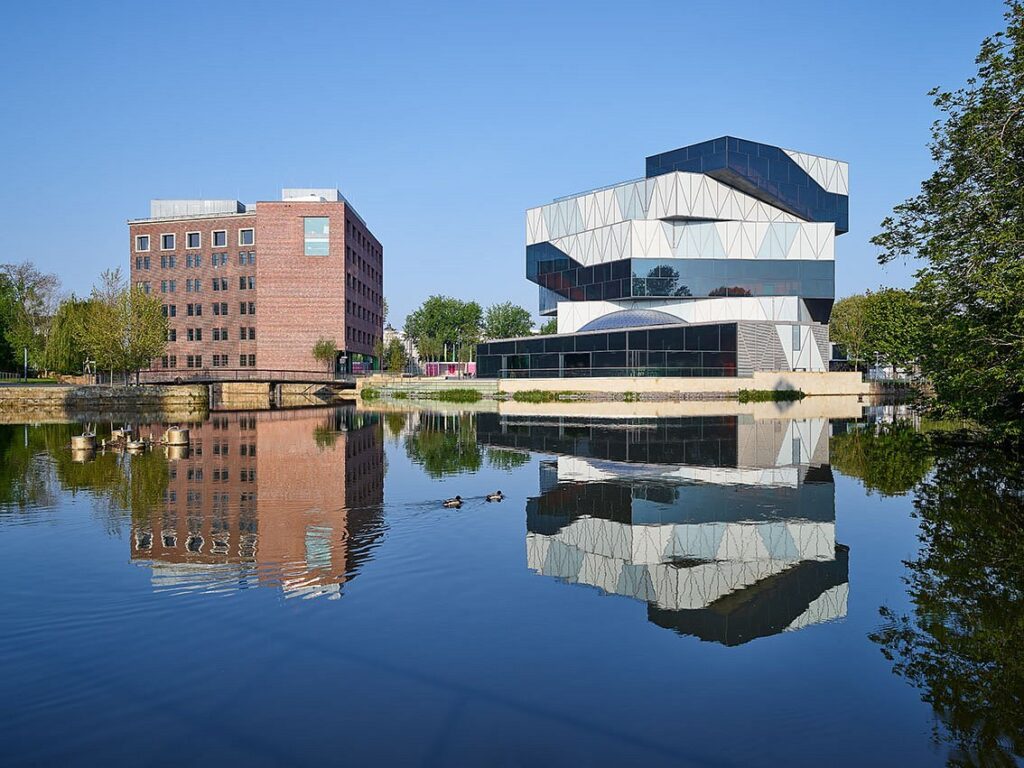
Das Symposium findet in der experimenta statt, Deuschlands größtem Science Center im Herzen von Heilbronn – einem aufstrebenden Quantenzentrum und einzigartigen Ort, an dem das Fachwissen nationaler und internationaler Forschungseinrichtungen zusammenkommt.
experimenta – Das Science Center
Forum der Experimenta
Kranenstraße 14
74072 Heilbronn
Sollten Sie für Ihren Aufenthalt in Heilbronn ein Hotelzimmer benötigen, können Sie einen Blick auf die Hotelempfehlungen der Stadt Heilbronn werfen.
Wir laden Sie ein, Beiträge sowohl für Vorträge als auch für Poster einzureichen, in denen Sie Ihre aktuellen Arbeiten und Erkenntnisse zu fehlertoleranten Quantenalgorithmen, Quantenfehlerkorrektur sowie angewandter Quanteninformatik für Materialwissenschaften und/oder Quantenchemie vorstellen. Zu den Themenbereichen gehören:
- Quantencomputing in der Quantenchemie
- Quantencomputing in den Materialwissenschaften
- Quantenfehlerkorrektur und Fehlertoleranz
- Quantenalgorithmen für wissenschaftliches Rechnen
Einreichung
Einreichungen sind ab dem 1. Dezember 2025 bis zum 31. März 2026 möglich. Hierfür bitten wir um:
- einen Titel
- eine kurze Zusammenfassung mit max. 250 Wörtern
- eine Kurzbiographie mit max. 100 Wörtern
Wir freuen uns auf innovative Beiträge und Impulse.
Prof. Dr. David Kreplin
Hochschule Heilbronn

Dr. Jan Schnabel
Fraunhofer IPA
Dr. Andreas Sturm
Fraunhofer IAO
Dr. Vamshi Katukuri
Fraunhofer IAO
Dr. Werner Dobrautz
CASUS
Die Veranstaltung ist voll ausgebucht, eine Registrierung ist leider nicht mehr möglich.
Dr. Jan Schnabel
Fraunhofer IPA
Dr. Vamshi Katukuri
University of Waterloo
Dr. Andreas Sturm
Fraunhofer IAO
Dr. Jan Schnabel
Fraunhofer IPA
Dr. Vamshi Katukuri
University of Waterloo
Dr. Andreas Sturm
Fraunhofer IAO
Dr. Jan Schnabel
Fraunhofer IPA
Dr. Vamshi Katukuri
University of Waterloo
Dr. Andreas Sturm
Fraunhofer IAO
Organisiert durch:
Fraunhofer IAO:
Dr. Vamshi Katukuri
Dr. Andreas Sturm
Dr. Anne-Sophie Tombeil
Chiara Stephan
Fraunhofer IPA:
Dr. Jan Schnabel

In Kooperation mit:
Center for Advanced Systems Understanding (CASUS):
Dr. Werner Dobrautz

Heilbronn University of Applied Sciences:
Prof. David Kreplin